
Fish assemblages are one of the four biological indicators used to analyze aquatic ecosystems
and are a crucial component of ecosystems. The present study was carried out from the major
rivers and their tributaries in Amravati district including Melghat landscape in Maharashtra.
Fishes were collected with the help of locals and fishermen by following a maximum random
methodology. Photographic evidence of fishes and ecological parameters concerning habitat was
recorded onsite and the specificity of fishes occurrence was studied.
Archives
October_2024
- Download: Full Text
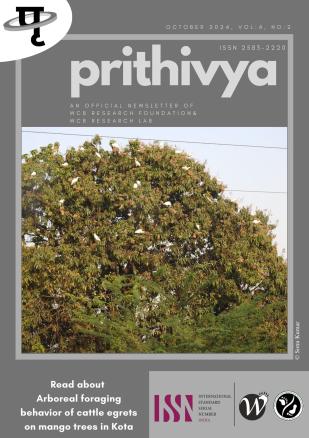
- The cattle egret (Bubulcus ibis) is a cosmopolitan bird species of egret and they are found in the tropics, subtropics and warm temperate zones. Cattle egrets are active foragers commonly seen chasing insects spread out by cattle’s or running to catch insects during ploughing and irrigating of farms. Arboreal foraging by cattle egrets has been reported a unique insight occasionally, although this behavior appears to be rare, less documented and not well understood or ignored because this phenomenon is so common.Download: Full Text
- This study presents a report of the occurrence of Neptis hylas (Linnaeus, 1758) in Bhavnagar district of western India, specifically from Mithi Virdi, Bhavnagar along with a review of known distribution from Gujarat. It is historically known to inhabit primarily in South Gujarat, with sporadic sightings in the central and northern regions of the state. The observation of this species outside its documented range raises intriguing questions about its potential for range expansion.Download: Full Text
- The two arthropodan species Conocephalus fuscus (Fabricius, 1793) and Humbertiella ceylonica (Saussure, 1869) were first observed and documented in the Anna University Campus in Chennai, Tamil Nadu. Species were identified based on photographs. There have been prior reports of these two species in two distinct areas of the nation. Humbertiella ceylonica, a mantodean species, was discovered in India, whereas Conocephalus fuscus an orthopteran species was discovered in many countries and recently in Pakistan (Sadiq et al., 2017).Download: Full Text
- Interactions between human beings and wild life coming from ancient times with a defining experience of human existence. These interactions may be in a positive or negative way. People compete with wild life for meals, shelter and other resources. With these interactions, they may find some beneficiaries and some time they face losses; even they can lose their life. Wild life is very important for maintaining the diversity and link in the ecosystem.Download: Full Text